
Stories and origin of Spring Festival 春节 chun jie, Chinese New Year Eve 除夕 chu xi, How to say “I wish you have a happy Lunar Chinese New Year, and may all your hopes be fulfilled ” in Chinese. Phrases – door god, red envelope, reunion meal, Teresa Teng 鄧麗君 恭喜恭喜 gong xi, gong xi Congratulations Congratulations New Year song

[audio:http://www.chinesetolearn.com/wp-content/uploads/2012/01/listen-to-sentence1.mp3|titles=listen to sentence]

How to say “I wish you have a happy Lunar Chinese New Year, and may all your hopes be fulfilled ” in Chinese: 祝你农历中国新年快乐,万事如意。Zhu4 ni3 nong2 li4 zhong1 guo2 xin1 nian2 kuai4 le4, wan4 shi4 ru2 yi4. Zhu4 (祝 verb, to wish) ni3 (你 pronoun, you) nong2 li4 (农历 noun, the lunar calendar, the traditional Chinese calendar) zhong1 guo2 (中国 proper noun, China, Chinese) xin1 nian2 (新年 xin means new, an adjective; nian means year, a noun; xin nian means new year) kuai4 le4 (快乐 adjective, happy) , wan4 (万 number, ten thousand, innumerable) shi4 (事 noun, things) ru2 (如 verb, obey or go along with) yi4 (意 noun, wish, thought, thinking).

First I would like to wish you a prosperous Dragon Year and a smooth and happy year of Chinese learning. There are some useful information you might want to know about Chinese New Year -- Spring Festival 春节 ( chun1 jie2).

1. The Spring festival
Spring Festival 春节 ( chun1 jie2) is the most important traditional and social festival in Chinese spoken world. Its significance is like Christmas Day to Christian world.

Spring Festival, according to historic documents, derives from heavenly deities and ancestor worships in the 商 Shang dynasty (1600 BC – 1046 BC). In 1912, China started using the Western calendar and joined the Western world in celebrating January 1 as New Year’s Day. However, all Chinese world, continues to celebrate the traditional Chinese New Year.

Before Spring Festival, every Chinese household started thoroughly cleaning their house with the hope to get rid of bad things and preventing diseases. On the day of December thirtieth, their pasting door-god (门神, men2 shen2) paintings and spring festival couplets (春联 chun1 lian2), is a way to pray for fortune and auspiciousness in the coming New Year.

On the New Year’s Eve -Chu2 xi4 除夕, all families gather and unite to enjoy an once a year gourmet dinner — reunion meal ( 团圆饭 tuan2 yuan2 fan4) . They enjoy the chatting among family members or go out to shoot off firecrackers, play dragon dance and lion dance, and stays up late or all night to guard the year (守岁 shou3 sui4, guard the year). When morning comes, folks go out to visit friends and relatives. Grownups usually give 压岁钱 (ya1 sui4 qian2, money given to children as New Year presents; it is also called hong2 bao1 红包, red envelop or red packets). The celebration of the Spring Festival lasts 15 days, from the first day till the 15th day of the first lunar month (the Lantern Festival 元宵节 Yuan2 xiao1 jie2).

2. The Chinese New Year Eve, we call it 除夕 chu2 xi4. There is a story about chu xi.

Long long time ago, somewhere in China, there was a ferocious monster called 夕 Xi4. At the end of the lunar New Year, Xi4 usually came out to attacks people and animals in the villages. At first, people ran away to escape Xi’s attack. Later, people gradually learned that Xi was afraid of color of red and noises. Thus, they came out fantastic ideas to get rid of the monster:

The villagers gathered together to conquer the monster by dressing themselves in red, lighting firecrackers, and beating gongs and drums. Their effort was so successful that Xi got scared tremendously and ran back to the mountain cave. So, since then, year after year they did that to 驱除夕兽 qu1 chu2 xi4 shou4. 驱除 Qu1 cu2 are similar meaning compound word, both characters mean to get rid of; Xi4 means the monster Xi4 and the shou4 means monster. For people usually did these things to chase Xi away on the thirtieth of Lunar December to 驱除夕兽 qu1 cu2 xi4 shou4, hence, that day, lunar December thirtieth was named 除夕 Chu2 Xi4 since then.

Chinese Spring Festival

and song
鄧麗君 恭喜恭喜 (Dec 1968) Congratulations, congratulations (on the coming of New Year)
Posted in Chinese culture, Chinese festivals, Chinese folktales, One Chinese sentence a day | Tagged , , , , , , , | Comments Off on Stories and origin of Spring Festival 春节 chun jie, Chinese New Year Eve 除夕 chu xi, How to say “I wish you have a happy Lunar Chinese New Year, and may all your hopes be fulfilled ” in Chinese. Phrases – door god, red envelope, reunion meal, Teresa Teng 鄧麗君 恭喜恭喜 gong xi, gong xi Congratulations Congratulations New Year song

Year of Dragon 2012 – long nian- symbolic meaning of dragon in Chinese culture, idiom ye gong hao long, proverb 望子成龙,望女成风 wang zi cheng long, wang nv cheng feng, dragon dance and Heirs of dragon song, Puff the magic dragon the Irish Rovers


According to the Chinese zodiac, the Year of 2012 is the Year of Dragon which will start on January 23, 2012 and end on February 9, 2013. Dragon is the fifth sign in the Chinese Zodiac, and it is the most revered animal among the 12 animals of Chinese Zodiac.

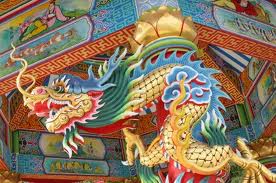
Today we can’t see the mythical and legend dragon in real life, still we can read them in ancient literature and admire them in paintings, sculptures and carvings . If you took some time observing the dragon in the painting, you will know that the Chinese dragon looks like a combination of many animals — a reptile, a snake, an alligator, and a lizard. Today, there is one kind of dragon we sometimes heard — beard dragon — a type of lizard. However that little reptile creature is definitely not the magnificent dragon in Chinese people’s eyes and minds. The creation of dragon is a grand rendition of Chinese people’s authentic imaginationary combination.

[audio:http://www.chinesetolearn.com/wp-content/uploads/2012/01/listen-to-sentence3.mp3|titles=listen to sentence]

Why Chinese people love dragon but not snake or other creatures? It is said that more than 4,000 years ago, there were two large tribes and many smaller tribes in ancient China. Each tribe used an animal as emblem, just like today’s sports team has its mascot. Those two large tribes combined together and used the dragon as their symbol. This is why still now, the 汉 Han tribe Chinese still call themselves the descendants of the Dragon (龙的传人 long2 de5 chuan2 ren2).

The Chinese people see dragons as a symbol of power, fortune, wisdom and superiority, unlike some western culture regards dragons as evil and threatening. In ancient China, dragon is the emblem of an emperor. Chinese emperors thought they were the real dragons and the sons of the heaven. So, the beds they slept on are called the dragon beds, the throne the dragon seat, and their ceremonial robes the dragon robes. When they were mad, it is called 龙颜大怒 (long2 yan2 da4 nu4 dragon’s face got greatly angry), and when they were happy, it is called 龙心大喜(long2 xin1 da4 xi3, the heart of dragon greatly pleased). Dragons’ paintings and sculptures can be seen on the walls, beams, ceilings and even roofs of the palace.

In Chinese astrology, a person that got born in the dragon year is fortunate and smart, and is predicted to stand out as someone special. That is why the birth rate in the Dragon Year is usually higher than other zodiac years. For Chinese parents want their sons to be 龙子 (long2 zi5, dragon son) and the daughters to be 龙女 (long2 nv3, dragon daughter). Chinese parents’ wish for their children is: 望子成龙,望女成风 (wang4 zi5 cheng2 long2, wang4 nv3 cheng2 feng4). This proverb means Chinese parents wish that their sons will grow up to be a dragon with wisdom, fortune, and strength and their daughters will grow up to be a phoenix (风凰 feng4 huang2) which is another magical animal in Chinese culture. (For info about phoenix, see my other post http://www.chinesetolearn.com/?p=1787) The famous Chinese actor Jackie Chan, his Chinese name is Cheng2 long2 (成龙, become dragon), and Bruce Li’s Chinese name is Li3 xiao3 long2 (李小龙,the little dragon lee). Now you should know why they have dragon in their names.

There is a Chinese idiom called 叶公好龙 (ye4 gong1 hao4 long2- ye4 is a surname, gong1 mean honorable gentleman, hao4 is fourth tone and functions as a verb- love, long2 dragon).

In the state of Chu of ancient China, there was a senior man, 叶公 Ye Gong, who was passionate about dragons. In his house, you can see the dragon pictures everywhere: walls, columns of building, household appliance, all decorated with dragon pictures or sculptures.

After hearing of Ye’s deeply crazy admiration about dragons, one day, a real dragon in Heaven flew to Ye’s house. At the sight of the real dragon, Ye Gong was so scared at what he saw, then he trembled with fear, finally he ran like a rocket fearing the dragon would eat him up.

叶公好龙 can be used as a metaphor to say a person just likes the surface look of something, but fears the inside of it; a pretended love for what you really fear.
This ironically idiom also is often used as an irony to describe those who act inconsistently with what they have said.

The dragon dance is the highlight of Chinese New Year celebrations held worldwide in Asia and China towns around the world. The purpose of doing dragon dance is to greet the good luck and good fortune into the coming New Year.

農曆新年傳統舞龍、舞獅 25022007

Let’s conclude the dragon post with the song — (龙的传人 long2 de5 chuan2 ren2)

For lyrics, pinyin, and English translation, see http://www.chinesetolearn.com/?p=572

Dragons

Puff The Magic Dragon – With Lyrics – The Irish Rovers

Posted in Chinese culture, Chinese festivals, Chinese idiom stories, Chinese proverbs, English song, One Chinese sentence a day | Tagged , , , , , , , | 8 Comments