[audio:http://www.chinesetolearn.com/wp-content/uploads/2012/01/listen-to-sentence4.mp3|titles=listen to sentence]
How to say ” He is a person with an iron fist in a velvet glove” in Chinese: 他是个外圆内方的人。Ta1 shi4 ge5 wai4 yuan2 nei4 fang1 de5 ren2. Ta1 (他 pronoun, he) shi4 (是verb, is) ge5 (个 measure word for person) wai4 (外 noun, outside) yuan2 (圆 adjective, round) nei4 (内 noun, inside) fang1 (方 adjective, square) de5 (的 particle to connect attribute and the noun it modifies) ren2 (人 noun, person).
外圆内方 (outside is round, inside is square) originally means the person’s outward appearance is tender,suave, and gentle; he or she acts like a circle (yuan2 xing2, 圆形) without any angles (jiao3, 角), very smooth (ping2, hua2, 平滑), but, inwardly, he is strong, solid , with unbending will (yi4 zhi4, 意志)and possesses strong integrity and firm on principles (yuan2 ze2, 原则). 外圆内方 can also be used to describe a style of interaction with others or taking care of business (sheng1 yi4, 生意). This kind of way of doing can be applied everywhere (dao4 chu4, 到处): in politics (zheng4 zhi4, 政治), business relations, foreign affairs, or daily work relations. A person with smooth way of doing or reacting with others is like one who hides an iron (tie3, 铁)fist (quan2 tou2, 拳头)in a velvet (rong2 绒)glove (shou3 tao4 手套). In contrast to the gentle appearance in peaceful days, when uneven time calls for the resolution and action, the person with firm heart and solid thinking is the one who is brave enough to unleash his iron first to settle thing determinedly.
There is another phrase: 有棱有角 you3 ling2 you3 jiao3 . You3 (有 verb, have) ling2 (棱noun, edge, angle) you3 (有, have) jiao3 (角, noun, angle, corner, point). This phrase literally (cong2 zi4 mian4 shang4, 从字面上)means the shape is sharp with clearly cut contour, but it also means a person’s doing is not smooth at all, and he or she is definite (ming2 que4 de5, 明确的)in his or her opinion (yi4 jian4, 意见). This type of person is easy to get into an argument or a fight with other people who have different view point.
In the voyage (hang2 cheng2, 航程)of life, we are like a rock with solid edges (bian1, 边) and sharp angles. As we went through the river of daily surviving (cun2 huo2, 存活), years after years, we went through the battle field of getting washed (xi3 shua1, 洗刷) by the strong currents and gentle waves, and the outer roughness of us got smoothed by experience (jing1 yan4, 经验)and learning (xue2 xi2, 学习). We become so called 园滑 yuan3 hua2 (smooth and cunning). We learn not to do thing in a harsh way. We are getting rounder and rounder in way of doing, also rounder and rounder in the body figure too !!!! Then we start to become a circle, thus, we roll and roll, for we will be so ancient that we won’t be able to walk anymore:( Dear readers, you should know this is a joke right?
Not all people become rounder and rounder when they aged. A lot of people I know are fit, agile and speedy too. It all depends on how we take care of ourselves. We are what we eat. We are what we sit. If we sit on a couch for long period of time everyday, we will become a couch (sha1 fa1, 沙发)potato (tu3 tou4 土豆,ma3 ling2 shu3马铃薯)someday, especially if you have a bag of potato chips or two or three ….
曾沛慈談自己:從有菱有角變圓滑and曾一度想逃離親友關心 曾沛慈 talked about herself: from a person of all angles and corners became a more smooth one, and once wanted to escape her relatives and friend’s concern and caring
Now, let’s hear a song — It is something soft, and something smooth, yes it is —
Stoney LaRue – Velvet
Posted inEnglish song, One Chinese sentence a day|Taggediron, iron fist, nei, person, rounder, Stoney LaRue, velvet glove, way|Comments Off on Learn Mandarin How to say ” He is a person who has an iron fist in a velvet glove” in Chinese: 他是个外圆内方的人。Ta1 shi4 ge5 wai4 yuan2 nei4 fang1 de5 ren2. phrases: 有棱有角 you3 ling2 you3 jiao3, literally 从字面上 cong2 zi4 mian4 shang4, literally, 原则 yuan2 ze2 principle Stoney LaRue – Velvet
[audio:http://www.chinesetolearn.com/wp-content/uploads/2012/01/listen-to-sentence6.mp3|titles=listen to sentence]
李白
Li Bai
清平調 (三首其一)
Qing ping diao (san shou qi yi)
Pure and peaceful tune (its first one of the three poems)
雲想衣裳花想容,
Yun2 xiang3 yi1 shang3 hua1 xiang3 rong2
Clouds remind us her raiment, and the flowers remind us her appearance.
春風拂檻露華濃。
chun1 feng1 fu2 kan3 lu4 hua2 nong2
Spring wind blows the railing, and the dews that were splendid and concentrated.
若非群玉山頭見,
ruo4 fei1 qun2 yu4 shan1 tou2 jian4 (note 1)
If not saw her at the peak of Jade mountains,
會向瑤臺月下逢。
hui4 xiang4 yao2 tai2 yu4 xia4 feng2 (note 2)
Then will meet her by chance on the precious jade terrace under the moonlight.
Note 1
There are a few Yushan 玉山 (Jade mountain). One I heard the most is the Yushan Mountain in Taiwan, and it is also the highest mountain of Taiwan Island too. However, the one in the poem is nothing to do with that Yushan Mountain at all.
In the Classic of Mountain and Sea, Yushan is the mountain where the Queen Mother of the West lives.《山海经》:“玉山是西王母所居也。” You might wonder who is this Queen Mother of the West.
Queen Mother of the West is an important character in the Chinese fairy tale. The legend of the Queen Mother of the West was first seen in the Warring States Period’s literature (the stories about King 穆王 Muwang and Xi Wangmu 西王母), but most scholars believe that the Queen Mother of the West originates from the gospel of the supernatural being and are related to the Taoism. As a prominent Daoist goddess, she was said to rule over the Western mountain paradise of Kunlun 崑崙.
For more information about the Queen Mother of the West, see http://www.egreenway.com/taoism/queen.htm
Note 2 Yao means beautiful jade. Tai terrace. Originally yao tai means a tower-like building ornamented with gems. This allusion can be found in Encountering Trouble of Chu Ci (The poetry of chu)《楚辞·离骚》:“望瑶台之偃蹇兮,见 有娥 之佚女。”
According to mythologies, for example 王嘉 Wang Jia’s The Record of Finders’ Keepers 《拾遗记》, 瑶台 yao2 tai2 is the place where immortals, supernatural beings or fairies live.
晋 王嘉 《拾遗记·昆仑山》:“傍有瑶台十二,各广千步,皆五色玉为台基。” 明 贾仲名 《金安寿》第四折:“你如今上丹霄、赴绛阙、步瑶台。比红尘中别是一重境界。” 元 本 高明 《琵琶记·牛相奉旨招婿》:“小娘子是瑶台 阆苑 神仙, 蔡状元 是 天禄 石渠 贵客。”
穆天子传》卷三:”天子宾于西王母,天子觞西王母于瑶池之上。西王母为天子谣曰:’白云在天,山陵自出。道里悠远,山川间之。将子无死,尚能复来。’天子答之曰:’予归东土,和治诸夏。万民平均,吾顾见汝。比及三年,将复而野。'”《武帝内传》称王母为”玄都阿母”。
Poem analysis:
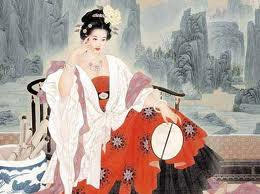
The poem and the other two in the same tune were written by 李白 Li Bai impromptu upon being summoned to the palace garden. At that time, Emperor Xuanzong 玄宗 (明皇) and his favorite concubine Lady Yang Yan Gui Fei 楊貴妃 (Yang is the family name, and Gui means valuable, Fei means concubine; Gui Fei is also one of the ranks of imperial consort in ancient China) (Yang Yuhuan 楊玉環) were admiring fully blooming peony flowers (牡丹花, Mu3 dan1 hua1).
The first line mentions about the beauty of Lady Yang. The follow are some different interpretations:
1. Clouds remind us her raiment(clothes), and the flowers remind us her appearance.
2. Her clothes are like clouds and her appearance is like flowers (the peony flowers that they were watching).
3. Clouds (think Lady Yang is so beautiful, so they) want her clothes, and the flowers (think her face is prettier, so they) want her appearance.
However, no matter which explanation, they all indicate some thing: Lady Yang is a beauty who dressed in splendid, lightly raiment, and she has a flower-like face. So beautiful, even her clothes are like heavenly sunset clouds. The delicate beauty is the key point of this line.
There is a Chinese phrase which says 人比花娇 ( ren2 bi3 hua1 jiao1 a person is prettier than a flower). This phrase is for female only. If you say this phrase to compliment a man, the compliment might become an insult; he might think you were mentioning he is a feminized guy. So, be careful:)
Line 2 describe the gentle spring breeze zephyred (let’s not mind the English grammar rule now, and use it as a verb) through the air and embraced the Lady when she was standing by the railings in the garden, and the dews on the flowers petals and the plants leaves are so splendid and concentrated. You might say ” wow, how I am supposed to feel for those little dews and make myself feel the same way as Li Bai felt?” Well, Li Bai was summoned to write poems about the prettiest female in China and the summon came from an Emperor, so tried to stand in his sparkling poetic shoes for an instance. Ask yourself, will you write something ugly there? No, you wouldn’t. Why? For if your poem is not beautiful enough, the emperor might get mad at you, and your official position might be in danger. So, now you know why a little dew became so grand like a golden coin in this line now:) There is a quote “A poet looks at the world the way a man looks at a woman.” (Wallace Stevens, Opus Posthumous) So, if you see every little dew as a fairy or a very exquisite lady, I am sure that you can come up something wonderful someday too!
Line 3 and 4 suggest that you can see Lady Yang either at Yushan or encounter her on the precious Jade terrace. Both of places as my notes explained all are the places where the immortal beings or fairies live, thus, these two lines express that the beauty of Lady Yang is so surreal, looks like a lady from the above i.e. a goddess, or fairy. In Chinese, there is a phrase 天女下凡 tian1 nv3 xia4 fan2 a fairy came down to earth, and that is exactly what Li Bai means in both lines -an ethereal beauty like a goddess came down from heaven to the ground.
Information about Yang Gui Fei 杨贵妃
Yang Guifei (杨贵妃), whose name was 杨玉环 Yang Yuhuan, was born into an official’s family in the Tang Dynasty (618-907 AD). Yang possessed rare beauty, she also was an accomplished singer and dancer. When she was 16, Yang married Prince Shou, who was Emperor Xuanzong’s 18th son.
Attracted by Yang Guifei’s beauty, Emperor Xuanzong wanted to marry her and forced her to divorce Prince Shou. She came to have such influence over the Emperor that many members of her family were appointed to high positions. Among them was Yang Guozhong, who assumed the post of Prime Minister.
Legend has it, one day Yang Guifei walked through the garden. Attracted by the beauty of the flowers, she touched one of the plants. That caused the flower’s petals and leaves to curl. One of the maids witnessed the event, and she told everyone the flower had bowed its head in shame after having seen Yang Guifei’s beautiful face.
Emperor Xuanzong was smitten by Yang Guifei and totally neglected his state affairs. Everyone came to hate her and her family because they felt they were causing the country’s downfall. This led to rebellion on the part of one of Xuanzong’s generals in 755 AD, who marched on the capital. The Emperor fled with Yang Guifei. They didn’t get far when his own royal guard troops refused to march any further unless Yang Guifei and Yang Guozhong were executed. The Emperor could do nothing but bow to their wishes. She chose to commit suicide instead. At age 38, she hanged herself.
The Secret History of Concubine Yang-Opening Theme
Poet Li Bai
LI BAI (701-762)
Li Bai is probably the best known Chinese poet in the West, and with Du Fu is considered the finest poet of the Tang dynasty. He has attracted the best translators, and as influenced several generations of American poets, from Ezra Pound to James Wright. Yet there is considerable confusion surrounding something as basic as his name. He is best known in the West as Li Po, though he is also called Li Pai, Li T’ ai-po, and Li T’ ai-pai, all of these being Wade-Giles transliterations of variations of his Chinese names (“Pai” and “Po” are different English transliterations of the same character). For each of these names there is a new English version, according to the now-accepted Pinyin transliteration system (Li Pai = Li Bai). To add to the confusion, Ezra Pound, in Cathay, his famous sequence of Chinese poems in translation, refers to him as Rihaku, a transliteration of the Japanese pronunciation of his name.
The facts of his life come to us through a similar veil of contradictions and legends. Where he was born is unknown–and there are those who say he was of Turkik origin–but it seems he was probably born in central Asia and was raised in Sichuan province. His brashness and bravado are characteristic of a tradition of poets from this region, including the great Song dynasty poet Su Shi. He claimed he was related to the imperial family, though this claim is likely to be spurious. Perhaps he wondered as a Taoist hermit in his teens; certainly Taoist fantasy permeates his work. He left his home in 725 and wondered through none Yangtze River Valley, hoping to gain recognition for his talents, though he was alone among the great Tang poets in never taking the Imperial Examination. He married the first of his four wives during this period. In 742, he was summoned to the capital of Changan, modern Xian, and was appointed to the Hanlin Academy (meaning “the writing brush forest”) by Emperor Xuanzong, and during his time in the capital he became close friends with Du Fu, who addresses a number of poems to him. Within a few years he was expelled from the court and made to leave Changan, and he began presenting himself as an unappreciated genius, or as one friend named him, “a banished immortal.” In 755, the An Lushan rebellion took place, in which a Turkish general led his group of Chinese border armies against the emperor. Li Bai was forced to leave Hunan for the South, where he entered the service of the Prince of Yun, sixteenth son of the Emperor, who led a secondary revolt. Eventually, Li was arrested for treason, sent into exile, and was later given amnesty. He continued his wanderings in the Yangtze Valley, seeking patrons, until his death at sixty-two.
About one thousand poems attributed to Li Bai have come down to us, though some of them were probably written by imitators. While most of his poems were occasional poems (poems written for specific occasions), others incorporated wild journeys, Sichuan colloquial speech, and dramatic monologues such as his famous “A Song of Zhanggan Village.” Perhaps the most remarkable subject for his poems, however, was himself. He portrays himself as a neglected genius, a drunk, a wanderer through Taoist metaphysical adventures, and a lover of moon, friends, and women. His colloquial speech, and confessional celebration of a sensual flamboyance and fallible self made him the best loved and most imitated Chinese poet in English and helped to establish a conversational, intimate tone in modern American poetry. Ezra Pound’s Cathay put him at the center of the revolution in modern verse. All these qualities, plus an extraordinary lucidity of image, made him extremely popular in China as well, in his day and to this day. A number of his poems are in the Han dynasty yuefu form, which allowed him to indulge in radically irregular lines that gave his imagination free play. He was an influential figure in the Chinese cult of spontaneity, which emphasized the poet’s genius in extemporizing a poem: “Inspiration hot, each stroke of my pen shakes the five mountains.” Among the many legends about Li Bai, the most enduring is the account of his death. Like Ishmael in the crow’s nest, wanting to penetrate the illusory world that he saw reflected in the water, Li Bai was said to be so drunk in a boat that he fell overboard and drowned, trying to embrace the moon reflected in the water. Since the “man in the moon” is a woman in Chinese myth, the legend of Li’s death takes on an erotic meaning, mixing thanatos and eros. As in Moby Dick, to “strike through the mask” and see the face of truth is to embrace death.