This song came from a classic Taiwanese movie — Papa, Can You Hear Me Sing? (Chinese: 搭錯車 da cuo che) is a famous 1983 tearjerker musical film directed by Yu Kanping (虞戡平 Yu Kanping) with leading actor Sun Yueh (孫越 Sun Yue) and leading actress Linda Liu (劉瑞琪 Liu Ruiqi). This film was released 8 times in Taiwan and 11 times in Hong Kong and won 4 Golden Horse Awards.
苏芮
Su Rui
Julie Su
请跟我来
Qing3 gen1 wo3 lai2
Please follow me
我踩着不变的步伐
wo3 cai3 zhe5 bu2 bian4 de5 bu4 fa2
I am treading the unchangeable paces
是为了配合你到来
shi4 wei4 le5 pei4 he2 ni3 dao4 lai2
To coordinate and prepare for your arrival
在慌张迟疑的时候
zai4 huang1 zhang1 chi2 yi2 de5 shi2 hou4
At the time of confused and hesitant
请跟我来
qing3 gen1 wo3 lai2
Please follow me
我带着梦幻的期待
wo3 dai4 zhe5 meng4 huan4 de5 qi2 dai4
I am carrying dreamy expectation
是无法按捺的情怀
shi4 wu2 fa3 an4 de5 qing2 huai2
Which are the unrestrained feelings
在你不注意的时候
zai4 ni3 bu2 zhu4 yi4 de5 shi2 hou4
At the time that you are not paying attention
请跟我来
qing3 gen1 wo3 lai2
Please follow me
别说什么
bie2 shuo1 shen2 me5
Don’t say anything
那是你无法预知的世界
na4 shi4 ni3 wu2 fa3 yu4 zhi1 de5 shi4 jie4
That is the world that you can’t predict
别说你不用说
bie2 shuo1 ni3 bu2 yong4 shuo1
Don’t say, you don’t have to say
你的眼睛已经告诉了我
ni3 de5 yan3 jing1 yi3 jing1 gao4 su4 liao5 wo3
Your eyes have told me
当春雨飘呀飘的飘在
dang1 chun1 yu3 piao1 ya5 piao1 de5 piao1 zai4
When the spring rains are floating and floating at
你滴也滴不完的发稍
ni3 di1 ye3 di1 bu4 wan2 de5 fa3 shao1
Your dripping and ceaselessly dripping hair tips
“Dream as if you’ll live forever, live as if you’ll die today.”
James Dean quotes
“Do not dwell in the past, do not dream of the future, concentrate the mind on the present moment.”
Buddha quotes
“Excellence can be obtained if you:
…care more than others think is wise;
…risk more than others think is safe;
…dream more than others think is practical;
…expect more than others think is possible.”
“To dream anything that you want to dream. That’s the beauty of the human mind. To do anything that you want to do. That is the strength of the human will. To trust yourself to test your limits. That is the courage to succeed.”
Bernard Edmonds quotes
“Happy are those who dream dreams and are ready to pay the price to make them come true.”
Leon Joseph Cardinal Suenens quotes
“The supreme object of life is to live. Few people live. It is true life only to realize one’s own perfection, to make one’s every dream a reality.”
Oscar Wilde quotes
“Love is an attempt to change a piece of a dream-world into reality.”
Henry David Thoreau quotes
“Dream what you want to dream; go where you want to go; be what you want to be, because you have only one life and one chance to do all the things you want to do.”
“Some people dream of success while others wake up and work hard at it.”
“We all have possibilities we don’t know about. We can do things we don’t even dream we can do.”
Dale Carnegie quotes
Posted inChinese songs, English song, Quotes|TaggedEnglish, English translation, pinyin, song|Comments Off on From 1980s Taiwan movie, classic duet dreamy song, 苏芮 Su Rui Julie Su 请跟我来 Qing gen wo lai Please follow me: Mandarin lyrics, pinyin, English translation, quotes of dreams, Josh Groban – To Where You Are
Mandarin Chinese – How to say – On the day of Dragon Boat Festival, I am going to see dragon boat races and eat yummy rice dumplings.
[audio:http://www.chinesetolearn.com/wp-content/uploads/2012/06/Dragon-Boat.mp3|titles=Dragon Boat]
端午節当天,我要去看龙船兢赛并吃好吃的粽子。duānwǔ jié dàngtiān , Wǒ yào qù kàn lóng chuánjīng sài bìng chī hǎo chīdezòngzi .
duānwǔ jié (節 jié means holiday, 端 duān means beginning, 午 wǔ the fifth month of lunar calendar is called 午月 wu yue, thus 午 wu means 五 wu; 端午節 duānwǔ jié means the holiday of the fifth day of the fifth month and thus, dragon boat festival) dàng (当 preposition, at (a time)) tiān (天 noun, day) , Wǒ (我 pronoun, I) yào (要 verb, want) qù (去 verb, go) kàn (看 verb, see) lóng chuán (龙船 noun phrase, dragon boat) jīng sài (兢赛 noun, competition or race) bìng (并 conjunction, and, as well as) chī (吃 verb, eat) hǎo chī (好吃adjective, delicious) de (的 particle to connect the attributive and the noun it modifies) zòngzi (粽子 noun, rice dumplings) .
[audio:http://www.chinesetolearn.com/wp-content/uploads/2012/06/Dragon-Boat1.mp3|titles=Dragon Boat]
Dragon Boat Festival (龙船节 Lóng chuán jié)
The 5th day of the 5th month of Chinese lunar calendar is the Dragon Boat Festival, which also is known as Duanwu Festival 端午節 (duānwǔ Jié) as well as the Double Fifth. In the year of 2012, it will be on June 23. The holiday in China will be celebrated from June 22 to 24, 2012. For 2013, it will be on June 13. Other names for this holiday include: Duanwu Jie 端午節; in Cantonese, they call it – Tuen Ng Festival; in Hokkien speaking commnities, by the names Gō͘-go̍eh-cheh/Gō͘-ge̍h-choeh 五月節 (Wǔyuè Jié) and Gō͘-ji̍t-cheh/Gō͘-ji̍t-choeh 五日節 (Wǔ Rì Jié).
In 2008, this holiday was first officially recognized as a public holiday in mainland China since the 1940s. However, the festival has long been celebrated in Taiwan, Hong Kong, Singapore, and Malaysia. In other parts of Asia, similar and related festivals include the Kodomo no hi in Japan, Dano in Korea, and Tết Đoan Ngọ in Vietnam.
Dragon Boat Festival is observed around the days when the daylight in the northern hemisphere is the longest. The dragon is like the sun (阳 yang) represents masculine energy; on the contrary, the moon (月 yue), like the phoenix (firebird, 凤凰 fenghuang), is a symbol of feminine energy. For this reason, Duanwu is naturally associated with masculine energy and power.
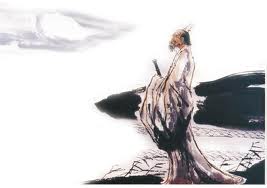
屈原的故事 The story of Qu Yuan — the patriotic poet and statesman who drowned himself
The origin and customs of Dragon Boat Festival:
The festival commemorates the patriotic poet 屈原 Qu Yuan (c. 340 BCE – 278 BCE), poet and statesman of the Chu 楚 kingdom during the Warring States period, and the holiday is also a time for people to clean their households, strengthen their bodies and dispel diseases.
Qu Yuan was descendant of the Chu royal house and also served as a minister in the State of Chu. Chu was one of the seven warring states before 秦 Qin (221BC – 206BC). Qu Yuan supported the decision to fight against the powerful State of Qin (one of the seven states during the Warring States Period (476 BC – 221 BC). However, when the king decided to ally with the increasingly powerful state of Qin, Qu was slandered by the aristocrat 子兰 Zi Lan, and later was accused of treason and got banished for opposing the alliance. During his exile, Qu Yuan wrote a great deal of poetry to express his love for his country. His works include 离骚 Li Sao (The Lament), 天问 Tian Wen (Asking Questions to the Heaven) and 九歌 Jiu Ge (Nine Songs), thus, Qu Yuan is now remembered as a great patriotic poet. Twenty-eight years later, Qin conquered the capital of Chu. In despair, after finishing his last masterpiece – 怀沙 Huai Sha (Embracing the Sand), Qu Yuan committed suicide by drowning himself in the 汨罗 Miluo River on the fifth day of the fifth lunar month.
On hearing of Qu Yuan’s tragedy, the local people, who greatly admired him, searched for his body by sailing their boats down the river; when the searching came out in vain, they dropped sticky rice triangles wrapped in bamboo leaves, the so called 粽子 zhòngzi (rice dumplings) into the river to feed fish and hope they would not eat away Qu Yuan’s body. Later, people in China, imitated these acts to show their respect for this great patriotic poet and so this practice continues till today.
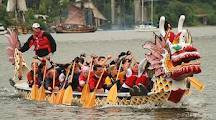
A dragon boat or dragonboat is a human-powered watercraft originally made of teak wood, in the Pearl River delta region of southern China – Guangdong Province, with various designs and sizes. Dragonboat races are a team paddling sport which has its roots in an ancient folk ritual of competing villagers held over the past 2000 years throughout southern China. Dragon boat races are traditionally held as part of the annual Duanwu Festival.
Dragon boat racing and eating zòngzi have become the central customs of Dragon Boat festival. Besides these two, there are two other Dragon Boat Festival customs which are related to health. The hot weather during solstice period, used to make virus and germs grow rapidly and bring various diseases. Dispelling disease and driving out evil thus became two main purposes of the Dragon Boat Festival. People would paste on their front doors pictures of 鍾馗 Zhongkui, a legendary Chinese ghost-catcher, to scare evils away. On this holiday, Chinese people will also hang mugwort (艾蒿 Aì Hāo) and calamus (菖蒲 chāngpú) on the side of door or windows to drive away mosquitoes and other insects, wear perfumed medicine bags (香包 xiāng bāo ) to offer beneficial effect to health, and drink realgar wine (雄黄酒 xiónghuáng jiǔ, Chinese believed realgar was an antidote for all poisons) to drive away evil spirits and kill insects. All of these activities are meant to prevent disease and evil as well as promote health and well-being.
How to make 粽子 zhòngzi:
First, you need to buy bamboo leaves (竹叶 zhú yè ) and washed them. My mom used to buy them from stores, but if you do live near a bamboo forest, then you can go out and pick some:)
Next you need to have glutinous rice, in Chinese we call it 糯米 (Nuòmǐ). You have to soak it for hours, then you fry it and add spices and other ingredients like pork, shrimps, or peanuts. Next, you wrap them in bamboo leaves and tie them with thin ropes and put them in a steamer and steam them. You can cook them in a bamboo steamer or any electric rice streamer.