丑小鸭,丑小鸭
chǒu xiǎo yā , chǒu xiǎo yā
Ugly little duckling, ugly little duckling
腿儿短短脚掌大
tuǐ ér duǎnduǎn jiǎo zhǎng dà
Legs are short and feet are big.
长长脖子扁嘴巴
chángcháng bózi Biǎn zuǐbā
(With) Long long neck and a flat mouth
走起路来摇摇摇
Zǒu qǐ lù lái yáo yáo yáo
When he is walking, he is always wobbling and swaying
爱到河边去玩耍
ài dào hébiān qù wánshuǎ
He loves to go to the riverside and play
喉咙虽小声音大
hóulóng suī xiǎoshēng yīn dà
Although her throat is little, his voice is big
可是只会呱呱呱
kěshì zhǐ huì guā guā guā
However, he can only quack, quack, quack
Translated by Shu
Quotes about ugly:
“I have found that all ugly things are made by those who strive to make something beautiful, and that all beautiful things are made by those who strive to make something useful.”
Oscar Wilde quotes
“In the name of the best within you, do not sacrifice this world to those who are its worst. In the name of the values that keep you alive, do not let your vision of man be distorted by the ugly, the cowardly, the mindless in those who have never achieved his title. Do not lose your knowledge that man’s proper estate is an upright posture, an intransigent mind and a step that travels unlimited roads. Do not let your fire go out, spark by irreplaceable spark, in the hopeless swamps of the approximate, the not-quite, the not-yet, the not-at-all. Do not let the hero in your soul perish, in lonely frustration for the life you deserved, but have never been able to reach. Check your road and the nature of your battle. The world you desired can be won, it exists, it is real, it is possible, it’s yours.”
Ayn Rand quotes
“Never pick a fight with an ugly person, they’ve got nothing to lose.”
Robin Williams quotes
“The ugly and the stupid have the best of it in this world. They can sit at their ease and gape at the play. If they know nothing of victory, they are at least spared the knowledge of defeat.”
Oscar Wilde quotes
“’You are drunk Sir Winston, you are disgustingly drunk. ‘Yes, Mrs. Braddock, I am drunk. But you, Mrs. Braddock are ugly, and disgustingly fat. But, tomorrow morning, I, Winston Churchill will be sober.”
Winston Churchill quotes
“War is so unjust and ugly that all who wage it must try to stifle the voice of conscience within themselves.”
Leo Nikolaevich Tolstoy quotes
“God help you if you are an ugly girl, ‘course too pretty is also your doom, ’cause everyone harbors a secret hatred for the prettiest girl in the room.”
Ani Difranco quotes
Posted inChinese children's songs, Quotes|TaggedDisney Ugly Duckling, lyrics, mandarin chinese, xiao|Comments Off on Cute lovely Mandarin Chinese children’s song 丑小鸭 chou xiao ya The Ugly Duckling: lyrics, pinyin, English translation, quotes of ugly, Disney Ugly Duckling movie, Duck song and Six little ducks
Chinese text:
[audio:http://www.chinesetolearn.com/wp-content/uploads/2012/06/Du-Fu-poem.mp3|titles=Du Fu poem]
風急天高猿嘯哀,渚清沙白鳥飛迴。
無邊落木蕭蕭下,不盡長江滾滾來。
萬里悲秋常作客,百年多病獨登臺。
艱難苦恨繁霜鬢,潦倒新停濁酒杯。
Annotated Chinese text with pinyin
風[fēng, noun, wind] 急[jí, adjective, hurried or fast] 天[tiān, noun, sky] 高[gāo, adjective, high] 猿[yuán, noun, apes] 嘯[xiào, verb, roar ] 哀[āi, adverb, sadly] ,渚[zhǔ, noun, a small island or islet] 清[qīng, adjective, clear] 沙[shā, noun, sand] 白[bái,adjective, white] 鳥[niǎo, noun, birds] 飛[fēi, verb, fly] 迴[huí, verb, circle or revolove] 。
無[wú, adjective, no] 邊[biān, noun, boundary] 落[là, adjective, falling] 木[mù, noun, wood] 蕭蕭[xiāoxiāo, wind brushes leaves sound, rustling, however, here used as an adverb] 下[xià, verb, fall or down] ,不[bù, adjective, no] 盡[jìn, noun, ending] 長江[cháng jiāng, Yangtze River, or Chang Jiang ] 滾滾[gǔngǔn, adjective, rolling, however, here used as an adverb] 來[lái, verb, come] 。
萬[wàn, number, ten thousand] 里[lǐ, noun, measure unit, Chinese mile / 500 meters (modern)] 悲[bēi, adjective, sorrowful] 秋[qiū, noun, autum] 常[cháng, adverb, frequently] 作[zuò, verb, be] 客[kè, noun, guest] ,百[bǎi, number, hundred] 年[ nián, noun, year] 多[duō, adjective, many] 病[bìng, noun, illness, disease] 獨[dú, adverb, alone] 登[dēng, verb, ascend or climb] 臺[tái, noun, terrace] 。艱難[jiān nán, adjective, difficult and challenging] 苦[kǔ, noun, bitterness] 恨[hèn, noun, hatred] 繁[fán, verb, multiply] 霜[shuāng, adjective, like frost, here means white] 鬢[bìn, noun, hair on the temples ] ,潦[lǎo, verb, to flood] 倒[dǎo, verb, to fall] 新[xīn, adverb, recently] 停[tíng, verb, stop] 濁酒[zhuó jiǔ, unfiltered rice wine] 杯[bēi, noun, cup] 。
Chinese text with pinyin and English translation
[audio:http://www.chinesetolearn.com/wp-content/uploads/2012/06/Du-Fu-poem.mp3|titles=Du Fu poem]
杜甫
Du Fu
登高
dēng gāo
Climbing the high terrace
風急天高猿嘯哀,渚清沙白鳥飛迴。
fēng jí tiān gāo Yuán xiào āi , zhǔ qīng shā Bái Niǎo fēi huí.
When wind blows hastily in high sky, apes roar sadly; above clear water and white sand of the small island, there are birds circling.
無邊落木蕭蕭下,不盡長江滾滾來。
wú biān luò mù xiāo xiāo xià , bù jǐn Chángjiāng gǔngǔn lái .
Without boundary, trees rustle leaves away; endless Yangtze River waves surge on arriving.
萬里悲秋常作客,百年多病獨登臺。
wàn lǐ bēi qiū cháng zuò kè , bǎi nián duō bìng dú dēng tái.
I traveled ten thousand miles as a guest in the sorrowful autumn; troubled by multiple sickness for like hundred years, now I am alone ascending the terrace.
艱難苦恨繁霜鬢,潦倒新停濁酒杯。
jiān nán kǔ hèn fán shuāng bìn , lǎo dǎo xīn tíng zhuó jiǔ bēi .
Hardship, bitter and hatred multiply my frost-like hair around temples; the wretched, frustrated life recently made me quit drinking from unfiltered wine cups.
Translated by Shu
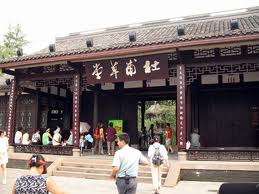
Introducing the great Tang poet Du Fu 杜甫
Du Fu (杜甫 712–770) was a prominent Chinese poet of the Tang Dynasty. Du Fu and Li Bai (李白 Li Bo) are called the greatest poets of the Chinese. Du Fu completed a traditional Confucian education and had an ambition to serve his country as a successful civil servant, but he twice failed the imperial examinations required for getting a civil service job. His life, like his contemporaries, was devastated by the An Lushan Rebellion of 755 安禄山之乱 An Lushan zhi luan . Du Fu traveled around the country, often without any money and his last 15 years were the most frustrated and unrest.
After his death, Du fu’s poetry became hugely influential in both Chinese and Japanese classic literature. He wrote about fifteen hundred poems which have been preserved till today. He has been called the “Poet-Historian” 诗史 shi shi and the “Poet-Sage” 诗圣 shi sheng by Chinese critics. He was a master of writing the lushi 律诗, or “regulated verse” genre.
Poem analysis:
This poem belongs to regulated verse (Lushi or lüshi, 律诗) category. Regulated verse is a specific form of Classical Chinese poetry. It is one of the most important poetry forms in classical Chinese poetry, the lushi refers to an eight-line regulated verse form with lines made up of five, six, or seven characters. This poem has seven characters in every line,the so called 七律 qilu — Seven-character eight-line regulated verse (七律 qilu): a form of regulated verse with eight lines of seven characters each.
Some common regulated verse requirements are they all are rhymed on the even lines, with one rhyme being used throughout the poem. Also, the tonal profile of the poem is controlled, and that is why it is called regulated; that is to say, the words in the lines need to follow certain tonal patterns.
風急天高猿嘯哀,渚清沙白鳥飛迴。
fēng jí tiān gāo Yuán xiào āi , zhǔ qīng shā Bái Niǎo fēi huí.
Does the opening look like Du Fu was having a happy mood? Not really. From which words you can tell it was not a poem written in good time? The first and the most significant one is 哀 āi. 哀 means sad. So, the poem starts from sad senses: sad ears to hear the sad roars of apes, sad eyes to see the falling leaves rustled away from trees, and the birds circled above the clear water and white sand (no rainbow colors here) with the hurried strong wind brushed through skin. So, yes, it is a sad poem …
Next the poet tells us what he saw: a forest of trees with leaves falling down in the rustling wind as well as the giant waves rolled on toward his view. Here, these two lines provide us the endless images by the tree leaves falling by the Yangtze River surging on. What the poet did not tell us in these two lines is his sorrowfulness: with a talented scholar like Du Fu himself, however his career was like a flat failure. With little to no funding, his life was a pretty hardship. Thus, what surging on his mind was the waves of misery and sadness.
Traveling is fun when you have time and money, but not for Du fu. He traveled for keeping himself alive, maybe it was walking to a new place to be a guest to a relative or a friend, or to find a minimal paying temporary job. Was the life as a guest good? Not very good, why we know? From this line 百年多病獨登臺 now I am alone ascending the terrace. He did not go out for hiking with a bunch of good friends or relatives, but was alone all by himself, a man with illness for decades. Sad, right?
Without money is OK as long as you have a strong and healthy body, but for the poet, sadly, he had none.
Chinese people say when people got tons of worries, they hair will turn white. The more worries and sorrow you have, the whiter your hair will be. This unlucky life experience full of hardship, bitter and hatred made Du Fu’s hair turned frosty color around temple areas. When people got endless sadness, some people would choose to get drunk to numb themselves; however, for our poor and miserable poet, he even got to quit drinking for running out of money to buy low quality unfiltered wine ….
The Spirit of Du Fu
Miley Cyrus – The Climb – Official Music Video (HQ)