Learn Chinese, Mandarin – How to say ” The opening scene of the movie is very dramatic.” 那部电影的开场非常戏剧化。Na4 bu4 dian4 ying3 de5 kai1 chang3 fei1 chang2 xi4 ju4 hua4. Na4 (那 pronoun, that) bu4 (部 measure word for movie) dian4 ying3 (电影 noun, movie) de5 (的 particle, to connect the modifier with the noun) kai1 chang3 (开场 noun phrase, opening scene; kai1 mean open, chang2 mean chang3 jing3 scene) fei1 chang2 (非常 adverb, very) xi4 ju4 hua4 (戏剧化 adjective, dramatic).
In the phrase 戏剧化 xi4 ju4 hua4 (adjective, dramatic)
the character 化 hua4 is a verb, and it functions as: become + N + ized
for example here
戏剧化
戏剧 is drama, so if we add 化, then 戏剧化 =become dramatized = dramatic
His story has a dramatic ending.
他的故事有戏剧化的结局。
Ta1 de5 gu4 shi4 you3 xi4 ju4 hua4 de5 jue2 ju2.
or
情绪化
情绪 is a noun means emotion, so add hua4 –情绪化=become emotionized = emotional
他的脾气很情绪化。
Ta1 de5 pi2 qi4 hen3 qing2 xu4 hua4.
His temper is very emotional.
or
西化
西 is a noun means the west, so add hua4 -西化 = become westernized
美国住久了,他的想法都西化了。
Mei3 guo2 zhu4 jiu3 le5, ta1 de5 xiang3 fa3 dou1 xi1 hua4 le5.
Have been living in the United States for a long time, his thinking all becomes westernized.
or
女人化
nv3 ren2 hua4
女人 is a noun means women, so add hua4 -女人化 = become feminized ( A guy possesses female characteristics)
他是男人可是他很女人化。
Ta4 shi4 nan3 ren2, ke4 shi4 ta4 hen3 nv3 ren2 hua4.
He is a man, but his action and behavior are like a woman.
There are some phrases contain hua4 you might want to know:
化桩 Hua4 zhuang1 Make up
她爱化桩。
Ta1 ai4 hua4 zhuang1
She loves applying makeup.
变化 bian4 hua4 change
这个变化不好。
Zhe4 ge5 bian4 hua4 bu4 hao3.
This change is not good.
化学 hua4 xue2 chemistry
化学课很有趣。
Hua4 xue2 ke4 hen3 you3 qu4.
Chemistry class is very interesting.
Now, let’s conclude this post with a song with the key character of the day. Guess what song it is? Yes, it is called 化 Hua4 🙂
This first video is in Cantonese
楊千嬅 化
The second one is Chinese / Mandarin version
楊千嬅 人情世故(化 國語版)
Posted inOne Chinese sentence a day|Taggeddian, hua, Learn, makeup, movie, noun phrase, westernized, Yang Qianhua|Comments Off on Learn Chinese, Mandarin – How to say ” The opening scene of the movie is very dramatic.” 那部电影的开场非常戏剧化。Also, phrases: feminized, chemistry, makeup, changes, westernized, and 楊千嬅 Yang Qianhua 人情世故 ren qing shi gu(化 hua) with lyrics
Decode Chinese characters – useful tips for recognizing characters longer and effectively: painting images in your mind or making a story for the character you wish to remember
Try to recognize Chinese Characters by rote is time consuming and the memory won’t last long. Seeing each Chinese character as a painting or continuous strips of story will aid essential visualization to your storage of Characters, make your recognition clearly and more interesting, and help you to build a lasting memory.
Most of Chinese characters are made of a few radicals or units. It is a good idea to study the parts first, then assemble the parts back to the whole meaning with these two ways. In order to do this approach, I suggest you to study at least 40 common radicals (部首 bu4 shou3). See my post about radicals to get more information about common radicals.
A Painting images on your mind
For example, the character 秋 qiu1 (autumn) is made of two basic radicals — 禾 he2 (crops) and 火 huo3 (fire). The time when you see the green leaves change to flaming red and orange and the farmers harvesting their abundant crops is the season of autumn. So, paint two images on your mind, both images vividly express the meaning of autumn.
So, next time when you see this 秋 qiu1 you will remember it right away that it is fall / autumn.
The character 早 zao3 means early. It consists of two radicals — 日 ri4 and 木 mu4. Ri4 日 is the sun and the mu4 木 means wood or trees. So, when you see the sun climbs up to the tree top, it is morning time. Morning is earlier than the noon or the night, thus, it has the meaning of early. Also, 早上 zao3 shang4 means morning, 早安 zao3 an1 means good morning.
The character 好 hao3 means good. It consists of two radicals 女 nv3 and 子 zi3. Imagine you are the man of the house, when you arrived home and saw your child and wife after a long day of working, you must have some **good** feeling? The ancient Chinese people thought that a man would be good and content as long as he has a wife and child – a wife to tend to his need and a child to carry his gene to next generation. So, paint a happy **good** family image for this character.
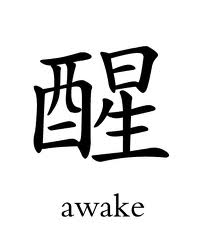
For the character above as you see in the picture, it is 醒 xing3 means awake. It consists of two radicals 酉 you3 (wine) and 星 xing1 (stars). What images popped into your mind when you saw the character. For me, it is a drunken person that fell asleep along the road side with a bottle of wine by the side, then, when he or she was awake, he or she opened the eyes and saw the stars in the night starry starry sky. The key point is the eyes opening part — taking in the twinkle stars and at that moment, he or she was finally awake from the drunkenness.
B Make a story for the character
Sometimes, it is hard to make images easily. When you feel some difficulty of creating the images, you need to have some creativity — try to make a story to it, no matter how silly, funny or ridiculous the story might be. so, learning Chinese can make you a creative person:)
Today, in my class, we were learning the character 重 zhong4 (heavy). I told the students to make a story for this character. Daniel said that the middle like the big face and the top and bottom like big hands and big legs for that person is very heavy.
I told him, “Yes, that is a fine story for you to recognize and memorize the word.” I said, besides that story, we can also think the middle is a big fat belly and the top part like the hands got squeezed up and hanging there, and the bottom part like the belly is so heavy and the legs got collapsed. The students laughed, and I bet they won’t forget this word easily 🙂
We also did another word lou2 楼 (multi- storied building). I told them, in ancient China, most houses were built by wood, so that is the radical we saw on the left side mu3 (wood). The bottom on the right side is the radical for 女 nv3 girl, and the upper one is 米 mi3 word (rice). I said, how about I remember this character by this story – Once upon a time, in a wood building, there was a starved girl. She always ate her bowl of rice while she was climbing up the stairs. The students felt the story was pretty ridiculous, but, as long as it can offer some mnemonic aid, it would still be useful.
A lot of people told me recognizing and memorizing Chinese characters are hard and boring. It can be yes or no, depend what approach you use. Remember when you first learned English, your teachers told you one of the most important strategies of reading is to chunk the word into little units, then blend them together and sound them out. Learning Chinese characters are the same – Chop the big pieces into little units and then assemble them to form the meaning — it can be etymological way, silly way or ridiculous way. However, as long as it works for you, it would be the best way and not complicated at all I hope:)
Hope you won’t feel too complicated at recognizing and deciphering the meaning of the Chinese characters you encounter. Have fun listening:)