Dear readers:
Here is another great website about Chinese Chess.
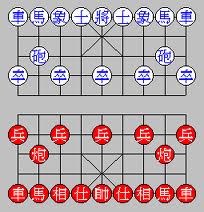
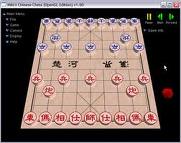
Xiangqi, known in the west as Chinese Chess, is an extremely popular game in the Eastern Hemisphere. It is currently played by millions (or tens of millions) in China, Taiwan, Thailand, Singapore, Vietnam, Hong Kong and other Asian countries. Xiangqi has remained in its present form for centuries. It is commonly believed that both Xiangqi and Orthodox Chess derive from the original Indian game of Chanturanga, but some, such as Sam Sloan and David Li, maintain that Chess is actually Chinese in origin. Whatever the relation between Xiangqi and Chaturanga, it seems highly likely that they are related, for the similarities between them are too hard to explain as just coincidences. The two games are played by approximately the same rules, and except for the Cannon, every Xiangqi piece is very similar to the Chaturanga piece that occupies roughly the same position and bears a name similar or identical in meaning.
 (xiáng)
  (qí) translates to Elephant Game. In Mandarin it is written as either Xiangqi, Xiang Qi or Hsiang-Ch`i and pronounced “Shiang-Chi”. In Cantonese it is written as Jeuhng Keih and pronounced “Junk Kay”. The name is written as two Chinese characters. The first is used in the game for the Elephant piece. The second means strategy game, and it also signifies one of the four arts — qin (music), hua (brush painting), shu (calligraphy) and qí (strategy games) — that a Chinese gentleman scholar was supposed to be proficient in. The word may have originally referred to the game now called Weiqi or Go, though in current usage it just means strategy board game.
There is much literature on Xiangqi, most of it in Chinese. There are, however, a few books available in English and other languages.
Rules
If you know how to play Chess, the rules of Xiangqi will be familiar. The general idea is the same. Each player controls an army of pieces, moves one piece at a time, and tries to get the opponent’s royal piece. It differs from Chess mainly in the object, the board, and the pieces.
Continue reading the article at: http://www.chessvariants.com/xiangqi.html