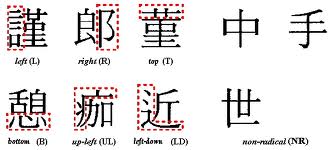
A Chinese radical (from the Latin radix, meaning “root”) is a component of a Chinese character. The term may variously refer to the original semantic (meaning-bearing) element of a character, or to any semantic element, or, loosely, to any element whatever its origin or purpose. The term is commonly used to describe the element under which a character is traditionally listed in a Chinese dictionary, which is often semantic but may sometimes be a phonetic or merely artificially extracted portion of the character. When used in this way as dictionary section headers (Chinese: 部首; pinyin: bùshǒu), radicals form the basis of an indexing system that has classified Chinese characters throughout the ages, from ancient Shuōwén Jiézì characters to their modern successors.
In an effort to make learning Chinese easier and boost literacy rates, in 1956 and again in 1964 the People’s Republic of China released a list of “simplified” Chinese characters which contain fewer strokes than their traditional equivalents. Although simplification of Chinese characters has occurred since the advent of Chinese script, this was the most intensive effort undertaken in modern times. In most cases radicals were simplified according to two basic rules:
* Several lines and/or dots became one line
* The traditional character or radical was replaced by a small, unique portion thereof
In some cases a combination of the rules was used although the difference between the traditional and simplified version of the same character can lie solely in the radical.[clarification needed] One example is the character for “language”; the traditional character is 語, whilst in the simplified 语 only the radical is altered.
人 rén – man, person
刀 dāo – knife
力 lì – power
又 yòu – right hand side
口kǒu – mouth
囗 wéi – enclosure Used as a radical only, not as a character itself
门 mén – door
土 tǔ – earth
夕 xī – sunset
大 dà – big, large
女 nǚ – female, woman
子 zǐ – son
寸 cùn – inch
小 xiǎo – little, small, young
工 gōng – labor, work
幺 yāo – tiny, small
弓 gōng – bow
马 mǎ – horse
心 xīn – heart
戈 gē – dagger-axe
手 shǒu – hand
日 rì – sun, day
月 yuè – moon
贝 bèi – cowry (shell)
木 mù – wood
水 shuǐ – water
火 huǒ – fire
田 tián – field
目 mù – eye
示 shì – to show
糸 mì – fine silk, Used as a radical only, not as a character itself
耳 ěr – ear
衣 yī – clothing
言 yán – speech
走 zǒu – to walk
足 zú – foot
金 jīn – metal, gold
隹 zhuī – short tailed bird
雨 yǔ – rain
食 shí – to eat