
《秋芸有春绿》
Qiu1 yun2 you3 chun1 lu4
Autumn rue has the greenery of spring
秋芸有春绿,疏篱照孤芳。
Qiu1 yun2 you3 chun1 lu4, shu1 li2 zhao4 gu1 fang1.
Autumn rue has the greenery of spring. The sparse fence reflects the lonely fragrant plant.
清霜早晚至,何草能不黄?
Qing1 shuang1 zao3 wan3 zhi4, he2 cao3 neng2 bu4 huang2.
Clear frost sooner or later will arrive. Which kind of grass would be able to not turn yellow?
宁当念衰落,政尔事容光。
Ning1 dang1 nian4 shuai1 luo4, zheng4 er3 shi4 rong2 guang1.
Rather to think about the coming decline now. At the present time work to decorate the appearance.
及时且自好,来日殊未量。
Ji2 shi2 qie3 zi4 hao3, lai2 ri4 shu1 wei4 liang2.
Without delay, at the time being we should treat ourselves well. The coming days will be different for they haven’t been measured yet.
Written by 范成大 Fan4 Cheng2 Da4 of Song Dynasty
From the book: The complete Shi and Ci poems of Fan4 Cheng2 da4
范成大诗词全集
Translated by Shu
Note:
1 芸 Yun2: Rue (Ruta) is a genus of strongly scented evergreen subshrubs 20–60 cm tall, in the family Rutaceae. A well-known species is the Common Rue.
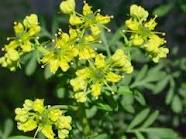
2. 芳 Fang1: Originally an adjective, means fragrant, however here is used as a noun to refer to the fragrant plant – rue.
3. 政尔 Zheng4 er3 means 正當 zheng4 dang1 — at this moment. It is a common phrase we found in Song Dynasty’s literature.
For example:
【政爾】正爾﹔正當。政﹐通“ 正 ”。 宋 辛棄疾 《永遇樂‧檢校停雲新種杉鬆戲
作》詞﹕“投老空山﹐萬鬆手種﹐政爾堪嘆。” 宋 楊萬裡 《過楊村》詩﹕“政爾清
和還在道﹐為誰辛苦不歸田﹖” 宋 陳巖肖 《庚溪詩話》卷下﹕“ 范蠡 忘名載 西子
﹐ 介推 逃跡累 山樊 。先生政爾無多事﹐聊把漁竿坐水村。”
4. 容光 Rong2 guang1: rong2 and guang1 both mean brighten up, and hence it means to decorate or do some makeup to beautiful the appearance.
5 Ji2 shi2 means timely, without delay.
6 且 Qie3 means zhan4 qie3 at the time being.
7. 殊 Shu1 means different.
Poem Analysis:
Lushi lüshi (traditional Chinese: 律詩; simplified Chinese: 律诗; pinyin: lǜshī; Wade-Giles: lü-shih) refers a specific form of Classical Chinese poetry verse form. One of the most important poetry forms of Classical Chinese poetry, the lushi was an eight-line regulated verse form with lines made up of five, six, or seven characters. This poem is a Five -character eight-line regulated verse (wulu):a form of regulated verse with eight lines of five characters each.
All lushi forms are rhymed on the even lines, with one rhyme being used throughout the poem. Also, the tonal profile of the poem is controlled and that is why it is called regulated verses.
The meaning is similar to Robert Frost’s poem
Nature’s first green is gold,
Her hardest hue to hold.
Her early leaf’s a flower;
But only so an hour.
Then leaf subsides to leaf.
So Eden sank to grief,
So dawn goes down to day.
Nothing gold can stay.
Both poems all lament about good things or good time won’t remain forever; as sad and depressing as it sounds, it’s true. 何草能不黄 and nothing gold can stay pretty much means happiness or youth or beauty won’t last forever. The lesson we learn from these two poems are: Make the best out of everything we have in hands, cherish the time and the people we love, and even things won’t last forever, at least we would have beautiful memories. Seeing from the positive side: the best thing is no one can steal your memory away 🙂